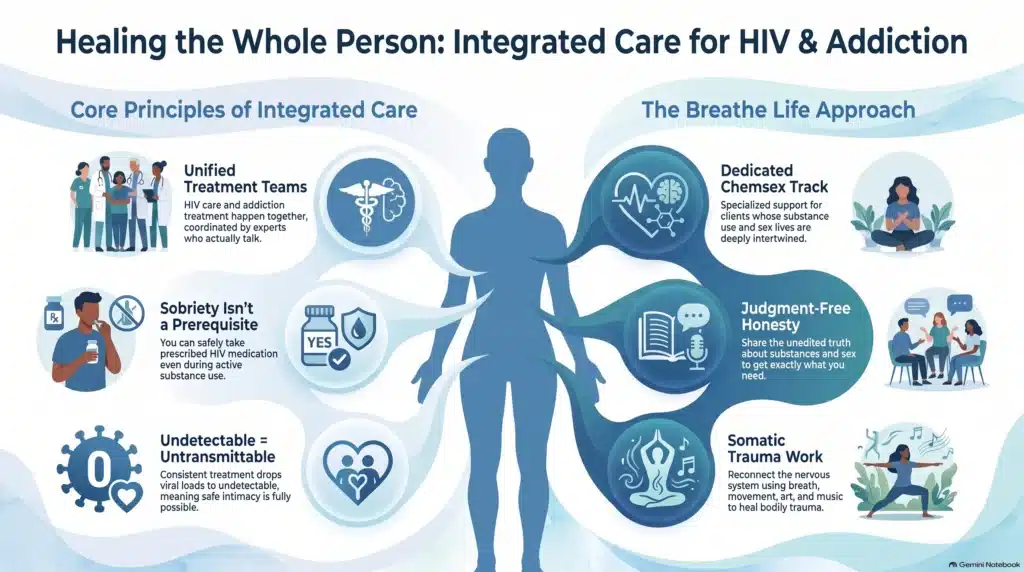



If you are queer and you have ever sat across from a therapist or counselor and spent the first twenty minutes of the session explaining what your pronouns mean, or why your chosen family is your family, or what being nonbinary actually looks like day to day, you already understand the problem with mainstream addiction and mental health treatment.
That is not a therapy session. That is unpaid labor. And it is labor that your straight, cisgender peers never have to do.
The treatment system in this country was not built for queer people. In many ways, it was built against them. Understanding why requires looking honestly at where the system came from, the impact it had, and what it will take to actually change.
How Has the Mental Health System Treated Queer People?
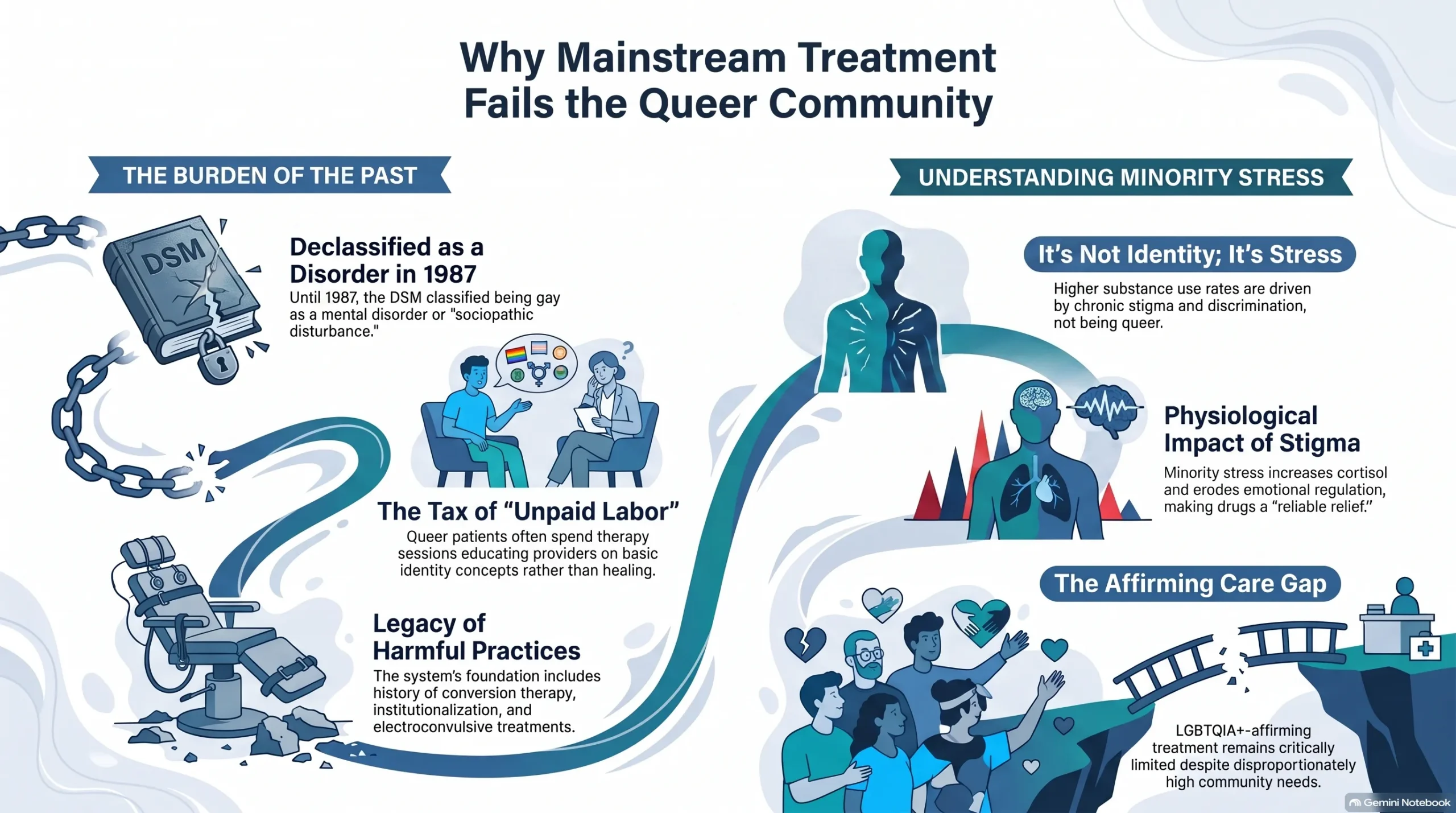
Until 1987, being gay was classified as some form of mental disorder in the DSM-5. The first edition of the DSM, published in 1952, listed it as a “sociopathic personality disturbance.” Later versions called it a “sexual deviation.” These classifications legitimized discrimination and have subjected the queer community to harmful treatments, including conversion therapy, electroconvulsive therapy, and institutionalization [1][2].
This is not ancient history. People who received those diagnoses are still alive. The clinicians who delivered them are still practicing in some cases. And the institutional and social culture did not disappear when the language changed.
The mental health and addiction treatment system that exists today was built on that foundation. That matters when we talk about why queer people do not seek treatment, do not stay in treatment, and do not get better at the same rates as their heterosexual and cisgender peers.
What Does the Research Actually Show About Queer People and Substance Use?
Queer people often experience higher rates of substance use disorders compared to heterosexual and cisgender populations. The driving force behind these disparities is not queerness itself. It is minority stress, the chronic, cumulative burden of stigma, discrimination, victimization, identity concealment, and the ongoing reality of living in a world that wasn’t shaped with you in mind [3][4].
Minority stress functions the same way other forms of chronic stress do. It impacts the nervous system, increases cortisol the stress hormone, erodes emotional regulation, and creates the conditions where drugs become the most reliable and available relief in the moment.
LGBTQIA+-affirming drug and alcohol treatment remains limited despite these disparities, and the gap between what the community needs and what the treatment system offers is one of the reasons Breathe Life Healing Centers was created.
 Why Mainstream Treatment Fails Queer People Even When It Tries to Be Inclusive
There is a version of inclusion that means a rainbow flag in the lobby and a line in the intake paperwork asking for preferred pronouns. Although often well-intentioned, that is not true affirming care.
Real barriers to treatment for LGBTQ+ people include:
- Fear of discrimination or rejection by staff
- Discomfort with heteronormative assumptions baked into group therapy formats
- The exhausting cognitive labor of managing your identity disclosure in a treatment environment
- The genuine clinical risk of being re-traumatized by a system that has treated your queerness as incidental to or separate from your mental health
Consider what it means to walk into a residential treatment program and be placed in a room with someone whose gender assumptions about you are wrong. To sit in a group therapy session where family is assumed to mean biological family. To have a counselor who has never encountered chemsex ask you to explain what party and play means before they can begin to understand what you are actually dealing with. To be told your relationship is not a real relationship because it does not fit the framework the program was built around.
These are not rare experiences. They are the norm in mainstream treatment for many queer people [3].
What Does Treatment That Actually Sees You Look Like?
Being treated by someone who understands your lived experience is a genuine medical benefit. The therapeutic relationship is one of the strongest predictors of treatment outcomes across all populations, and a therapeutic relationship requires trust. Trust requires feeling seen. And feeling seen requires a provider who does not need you to educate them first.
Treatment that actually sees queer people looks like:
An intake process that does not assume your gender, your relationship structure, or what family means to you.
A clinical team that understands the minority stress model and treats systemic harm as a legitimate clinical part of the picture rather than background noise.
Group therapy that reflects the actual diversity of queer experience, including trans, nonbinary, and bisexual people. And people whose sexuality and gender identity do not fit the binary frameworks that most programs were built around.
A program where you do not have to leave or hide parts of yourself at the door to receive care.
Where your identity is not an obstacle to your treatment and where the people supporting your recovery have lived some version of what you have lived, which means you can spend your energy on healing instead of explaining.
 Why Breathe Life Healing Center Exists
Our program in Laurel Canyon, Los Angeles, was founded on the belief that queer people deserve treatment that was designed with their full humanity in mind, not reformed to accommodate it.
Our clinical team includes people with lived experience in recovery and in the community. Our CEO, Beck Gee, is a trans man in recovery himself. When you walk through our doors, you are not an exception to the program, you are who the program was built for.
We treat the full spectrum of substance use disorders and co-occurring mental health conditions, alongside the specific, documented realities of queer life that mainstream treatment has historically not known how to hold, including religious trauma, identity-based stress, chosen family dynamics, chemsex and sexualized drug use, hormone continuity for trans clients, and the chronic, compounding weight of navigating a world that has not always made space for you.
You should not have to earn the right to be seen in treatment. We are ready to support you.
Sources:
[1] Drescher, J. (2015). Out of DSM: Depathologizing homosexuality. Behavioral Sciences, 5(4), 565–575.
[2] NAMI San Bernardino. (2024). When homosexuality stopped being a mental disorder in the DSM. NAMI San Bernardino Area.
[3] Paschen-Wolff, M. M., et al. (2024). Experiences of and recommendations for LGBTQ+-affirming substance use services. Substance Abuse Treatment, Prevention, and Policy, 19, 2.
[4] Radi, N., et al. (2025). Substance use disorders at the intersection of gender, sexuality, and race/ethnicity. Drug and Alcohol Dependence.
[5] Hodges, J. C., et al. (2023). Sexual minorities and substance use treatment utilization: New evidence from a national sample. Journal of Substance Use and Addiction Treatment, 150, 209060.