


If you have ever used drugs or alcohol to get through something that felt impossible, the root is not about weakness or bad decisions. It is about what happens to a body and a nervous system that has been under chronic, identity-based stress for years, sometimes decades, sometimes since childhood. That stress has a name. It is called minority stress.
Minority stress is not just having a bad day because someone said something ignorant. It is the chronic burden of living in a society that treats your identity as a problem or something to just be “tolerant of.” In many instances, your identity may not be acknowledged at all [1].
Understanding minority stress does not dismiss the need for treatment, but it finally gives the right name to something that too many queer people have spent years blaming themselves for.
What Is Minority Stress and Why Does It Matter?
Minority stress includes the discrimination you can point to and the discrimination you cannot, such as the job interview that went nowhere after you mentioned your partner, the apartment application that was suddenly unavailable, and the family dinner where you spent three hours managing what you said and how you said it. It includes systemic stress such as discrimination or hostile work policies, as well as individual stressors like internalized shame and the exhaustion of concealing or masking your identity [2].
What distinguishes minority stress from the stress everyone experiences is its origin. Anyone can lose a job. But losing a job because your employer found out you are trans, or being denied housing because your landlord clocked you as gay, is a different category of stress. It is rooted in prejudice, it is chronic, and it compounds over time in ways that standard stress models were never designed for [3].
What Does Minority Stress Look Like in Real Life?
It can look like coming out as bisexual and having your family respond by questioning whether this is just a phase. It can look like a 40-year-old gay man who has been out for two decades, who grew up in the era of the AIDS crisis, and who watched his community lose people at a scale and speed that mainstream society and political leaders treated as an acceptable tragedy.
It can look like a nonbinary person who uses they/them pronouns and has to correct every new doctor, employer, and person they meet. The load of that constant correction and recorrection is its own form of chronic stress, and it takes a toll that shows up in the body.
It can look like a trans woman of color experiencing three overlapping systems of racism, transphobia, and misogyny, whose rates of discrimination, violence, and housing instability are among the highest of any population in the country [4].
When drugs become the most reliable way to feel safe in a body that the world has told you is wrong, that is not a character flaw. That is survival.
 How This Impacts Queer Health and Increases the Risk of Substance Use
A nervous system that has never been able to fully relax is a nervous system that is more likely to use drugs or alcohol to feel relief. Alcohol quiets a restless mind that cannot quiet itself, meth produces the confidence and connection that shame has made otherwise inaccessible, and substances often offer a break from hypervigilance, tension, or chronic pain that nothing else reliably provides.
The stress does not just create vulnerability, it shapes the trajectory of how drug use often develops [6].
What Does This Mean for Treatment?
It means that treating addiction in queer people without addressing minority stress is treating a symptom while leaving the cause in place. A treatment environment where you have to fight to be correctly gendered, or where if you’re bisexual you’re told to “just pick a side,” is not a neutral environment. It is an environment that replicates the very conditions driving the addiction.
Affirming, community-rooted, identity-conscious care is not a “nice benefit” for queer people seeking treatment. It is clinically necessary.
Gender-Affirming Mental Health Care and Addiction Treatment for the Queer Community at Breathe Life
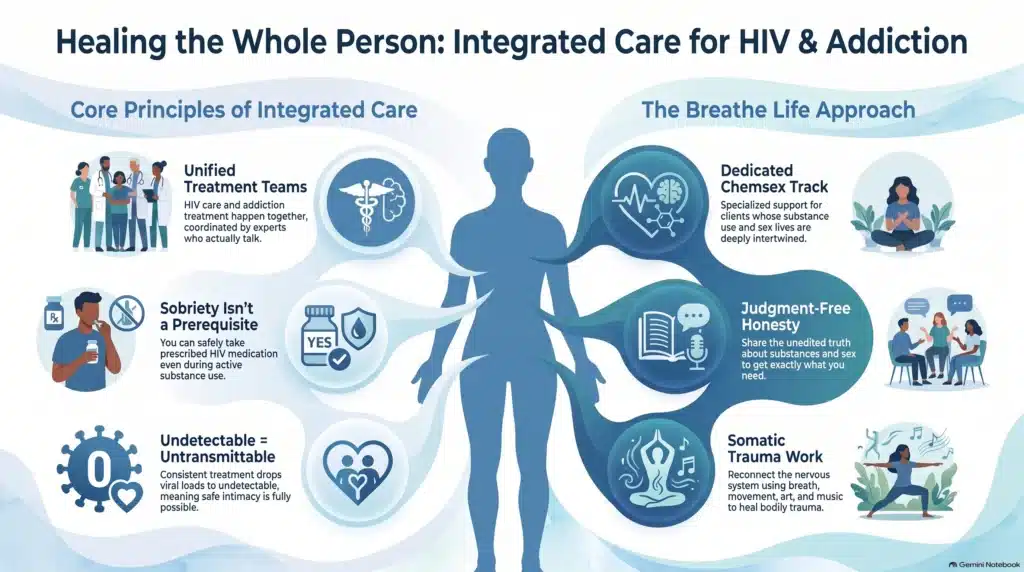
At Breathe Life Healing Centers in Los Angeles, we built our program around the understanding that you cannot heal from something that is still happening to you. Minority stress is not in the past for most queer people. It is still experienced on a daily basis. And treatment that does not acknowledge that, name it, and work with it clinically is not going to produce the outcomes that people deserve.
Our clinical team understands minority stress not as an abstract framework but as the lived reality of the people we serve. Many of our staff are queer and in recovery themselves. Our programs are designed to address both the substance use and the conditions that drove it in an environment where your identity is central to your care.
You deserve treatment that sees all of you. We are here when you are ready.
Sources:
[1] Miller-Perusse, M., et al. (2025). Minority stress and stimulant use among US adult sexual minority men: A systematic review. Drug and Alcohol Dependence Reports, 15, 100333.
[2] Meyer, I. H. (2003). Minority stress model overview. ScienceDirect Topics.
[3] Watson, R. J., et al. (2023). Self-compassion, minority stress, and mental health in sexual and gender minority populations: A meta-analysis and systematic review. Clinical Psychology.
[4] Pellicane, M. J., et al. (2025). Reducing disparities and improving mental health for transgender persons. PMC, National Library of Medicine.
[5] Serrano, V. B., et al. (2025). Associations among minority stress, allostatic load, and drug and alcohol use in sexual minorities: Protocol for the Queer Health Study. JMIR Research Protocols.