


There is a version of using Grindr and dating apps that is healthy, fun, and genuinely connecting. Hookups are fine. Casual sex is fine. None of that is the problem. The problem shows up when the apps become the primary way you regulate your emotional state.
When you open a dating or hookup app at 2 AM, what are you actually looking for? When you say yes to a PnP invite, what need is that meeting? Is it pleasure? Connection? Escape? Numbness? A way to feel desired when you otherwise feel invisible? A way to feel anything at all?
None of those questions make you broken. They make you human. But they are worth knowing, because the answer shapes whether your sex life is something that is adding to your quality of life or quietly taking from it.
Apps like Grindr and Sniffies have given people access to community, sexual exploration, and connection they could not find anywhere else, especially in places where being queer still carries real risk. But there is something happening inside that culture that is worth talking about honestly. And the honest conversation is not just about drugs. It is about what the drugs are doing for us that we have not found another way to get.
The Link Between Drug Use and Hookup Culture in Gay Communities
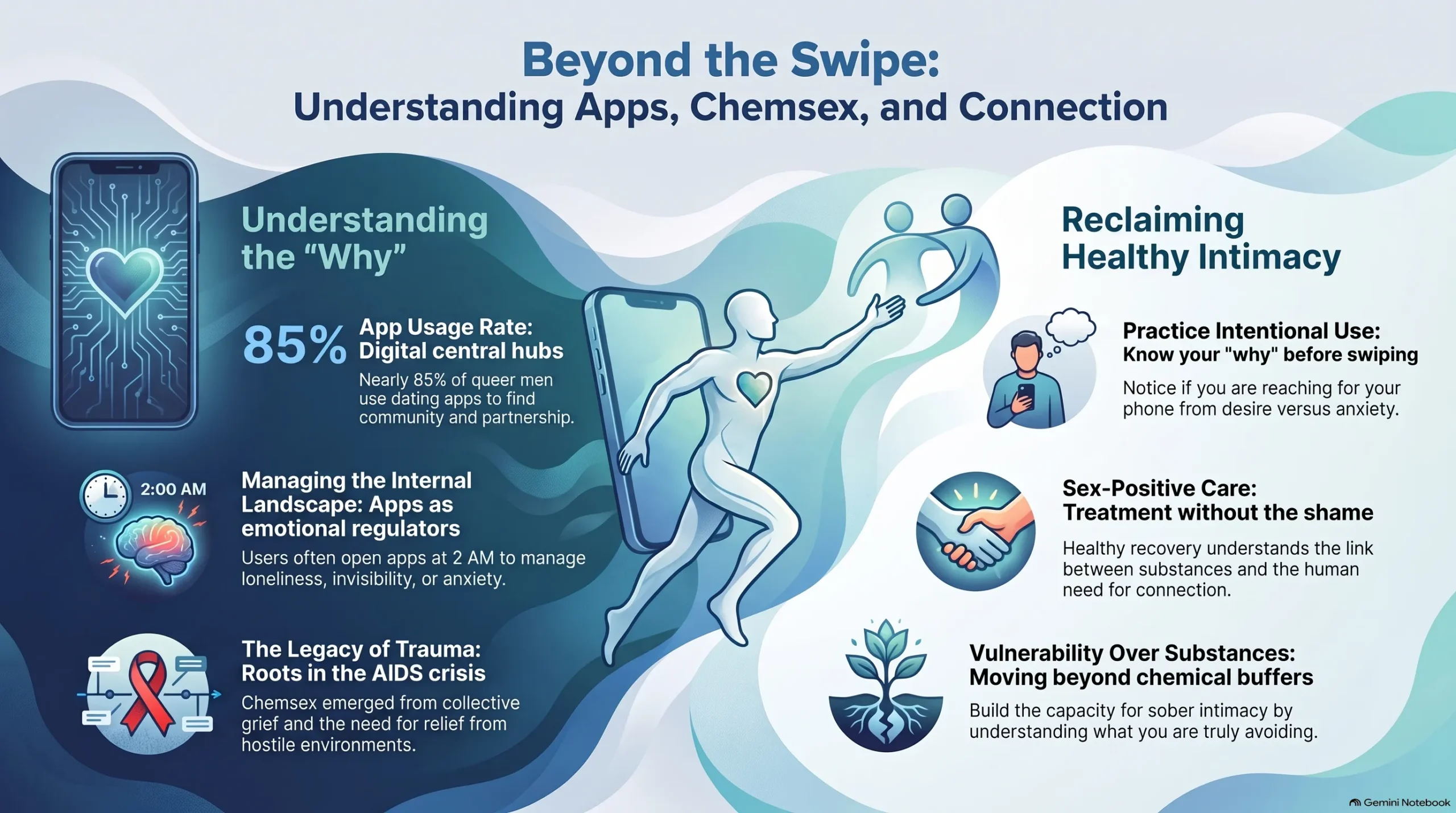
Nearly 85% of queer men report using a dating app to meet a partner. These platforms are central to LGBTQIA+ social and sexual life, and many report finding meaningful, healthy partnerships in these apps.
However, research also consistently shows that chemsex (sexualized drug use) is significantly more common among them [1] [2].The question people rarely ask is why. Not in a judgmental way. But in a genuinely curious, clinically honest way.
The answer is not that queer men have worse impulse control or like getting high more. The answer is history, trauma, and the very specific experience of growing up in a world that told you your desire was wrong before you even understood what desire was.
 What Role Did the AIDS Crisis Play in All of This?
An entire generation of people watched their communities decimated in the 1980s and 1990s while the government largely looked away. Sex became entangled with death in a way that has no parallel in the experience of straight people. The grief was collective, the loss was staggering, and for many, it was processed with drugs and alcohol.
Queers who survived that era and the generations who came after them inherited something: a complicated relationship with sex, bodies, intimacy, and mortality that did not resolve when the crisis did.
Chemsex culture did not emerge from nowhere. It emerged from a community struggling with unprocessed grief, hostile or dangerous political structures, and survival. People needed relief from something enormous and found it in the combination of substance use and sex.
The Impact of Hookup Apps on Intimacy
Dating apps are associated with higher distress, and 86% of studies found a strong association between regular app use and negative body image [3]. It does not mean they are inherently bad or shouldn’t be used. But the architecture of these platforms, the instant judgment, and the way desire gets commodified into a quick swipe left or right can impact how we experience ourselves and each other.
You can spend three hours on Grindr and come away feeling more alone than when you started, not because nothing happened but because what happened did not give you the feeling or true connection you were looking for. For some, drugs fill that gap.
Meth lowers the inhibition that makes real vulnerability feel impossible.
GHB softens anxiety enough to actually be present with another person.
Research on chemsex consistently finds that people describe using drugs to manage anxiety around intimacy, to feel more comfortable in their bodies, and to access a sense of connection that feels otherwise unavailable to them [4]. That is not a lack of self-discipline or a morality problem. That is a nervous system finding the fastest available route to something it genuinely needs.
What a Healthier Relationship With Sex and Apps Can Look Like
Using apps with more intention does not mean using them less, or giving up casual sex, or becoming someone who only dates with a relationship in mind. It means knowing what you are there for before you open them.
It means noticing when you are reaching for your phone from genuine desire versus from loneliness, anxiety, or a need to feel wanted that probably will not get met by a hookup. It means being honest with yourself about whether substances have become necessary for sex to feel possible, good, or safe.
And it means asking whether the sex you are having is the sex you actually want, with the level of presence and connection you actually want, or whether it is a reasonable substitute for something you have not yet figured out how to access sober.
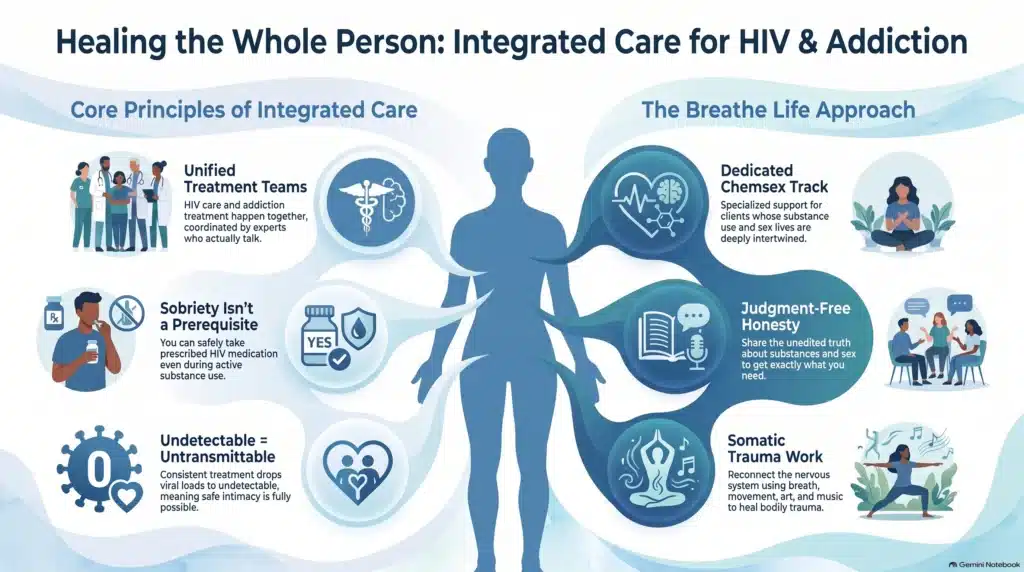
Chemsex and Intimacy Treatment at Breathe Life Healing Centers
At Breathe Life Healing Centers in Los Angeles, our chemsex track is one of the only programs in the country designed specifically for the queer community whose drug use is entangled with sex, intimacy, and the particular emotional landscape that comes with it.
We do not treat your sexuality as a problem. We do not conflate chemsex with sex addiction. We do not use shame as a clinical tool.
We use sex-positive care to help you understand the relationship between what you have been using, what you have been avoiding, and what you actually want, and build the capacity to access that without needing a substance to get there first. When you are ready, we are here to connect with and support you.
Sources:
[1] Hecht, J., et al. (2025). Swiping for connection: tribe identity and sexual health among sexual minority men who use dating apps. Frontiers in Communication.
[2] Donndelinger, S. (2025). How apps like Grindr and Sniffies are fueling the meth crisis among gay men. LGBTQ Nation.
[3] Zervoulis, K., et al. (2019). Use of gay dating apps and its relationship with individual well-being and sense of community in men who have sex with men. ResearchGate.
[4] Mundy, L., et al. (2025). The complex social, cultural and psychological drivers of chemsex experiences of men who have sex with men: a systematic review. PMC, National Library of Medicine.